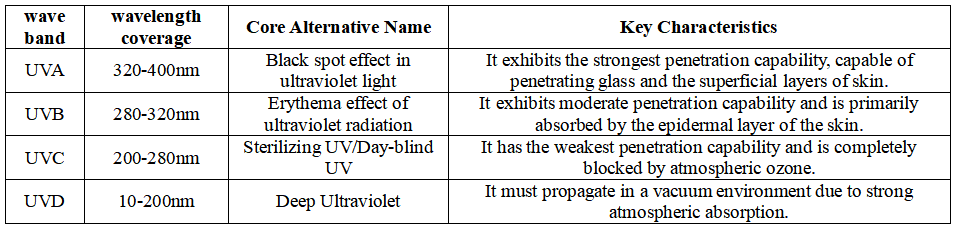
Ultraviolet (UV) radiation, as the critical spectral region between visible light and X-rays within the electromagnetic spectrum, is not merely an "invisible add-on"; rather, it serves as a fundamental technological driver for innovation in modern industries, medicine, semiconductors, and other fields. According to internationally accepted classifications, the UV spectrum can be divided into UVA (long-wave UV), UVB (medium-wave UV), UVC (short-wave UV), and UVD (vacuum ultraviolet).
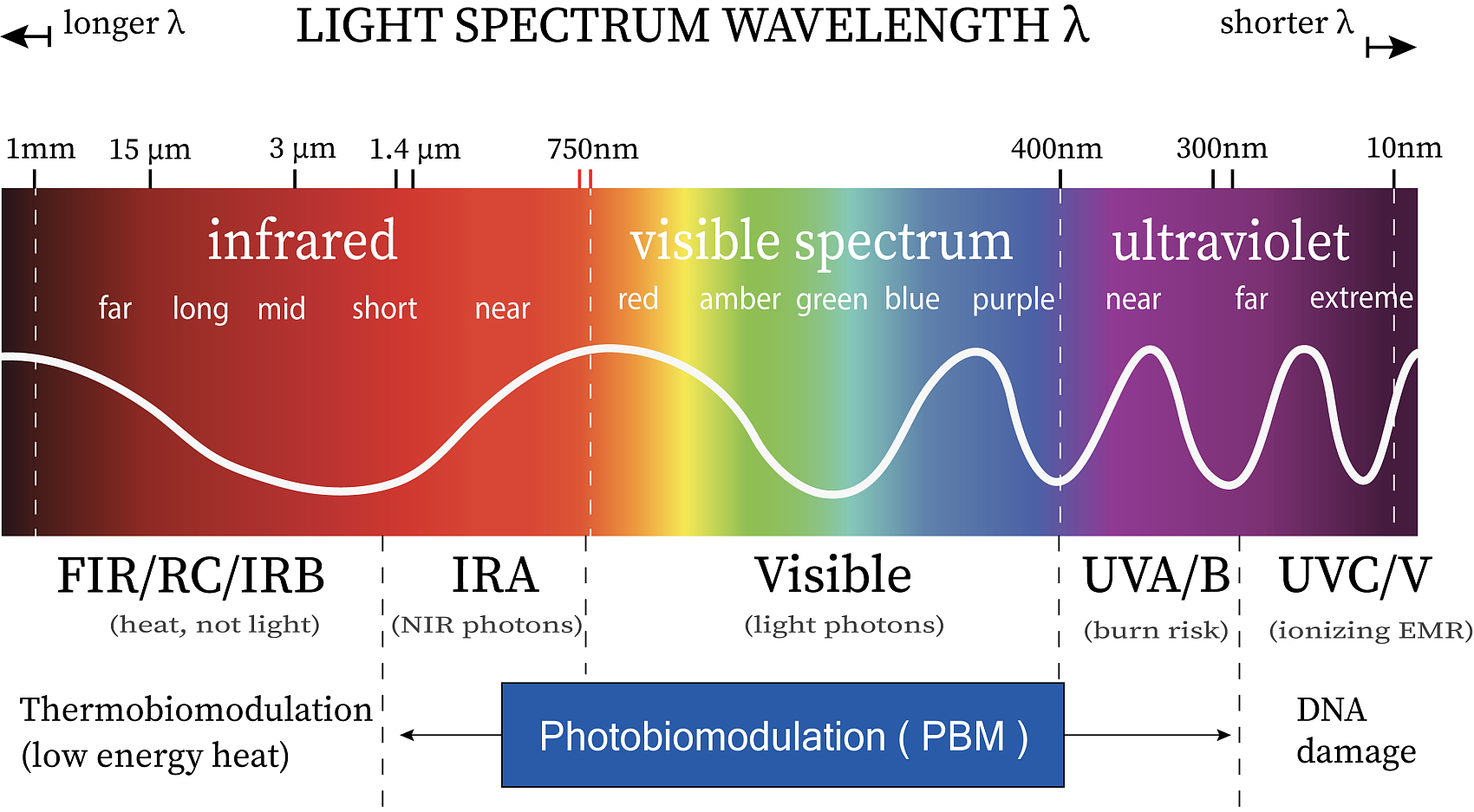
In nature, sunlight serves as a natural source of ultraviolet (UV) radiation. After being filtered by the atmosphere, the UV radiation reaching the Earth's surface primarily consists of UVA (approximately 95%) and a small amount of UVB (approximately 5%), while UVC is almost entirely absorbed by the ozone layer. Additionally, in industrial, medical, and disinfection applications, we are exposed to artificial UV light sources, which can be categorized into the following types:
1. gas discharge lamp
Gas discharge lamps are the most commonly used artificial UV light sources, generating ultraviolet radiation through gas ionization. Depending on the filling gas and structural design, they are classified into the following subtypes:
(1) Low-pressure mercury lamp
lPrinciple: Mercury vapor ionizes under low pressure, emitting characteristic spectral lines.
lCore wavelength bands: 185 nm (UVC), 254 nm (UVC)
lCharacteristics: low cost, high quantum efficiency at 254 nm, and mature technology; however, it contains mercury, faces environmental restrictions, and generates ozone at 185 nm.
lApplications: Air/water disinfection, surface sterilization, photolithography, ozone generation.
(2) Medium-pressure mercury lamp
lPrinciple: Under high pressure, mercury vapor ionizes, emitting continuous spectral lines.
lCore wavelengths: 254 nm, 365 nm, 405 nm (covering UVC/UVB/UVA).
lCharacteristics: High power output, strong light intensity, broad spectral width; contains mercury, generates significant heat, and requires cooling.
lApplications: Industrial curing (coatings, inks, adhesives), wastewater treatment, photolithography.
(3) Mercury-free excimer lamp
lPrinciple: A mixture of rare gases (xenon, krypton, argon) and halogens is excited by high-voltage electricity to form an excimer, which emits ultraviolet light of a single wavelength upon de-excitation.
lCore wavelengths: 172 nm (Xe?), 222 nm (KrCl), 308 nm (XeCl)
lCharacteristics: mercury-free and environmentally friendly, single narrow wavelength band, customizable wavelength, cold light source (low thermal radiation); relatively high cost and lower power density.
lApplications: 172 nm – surface cleaning, modification, and lithography; 222 nm – coexistence disinfection between humans and machines (safe and non-invasive), medical disinfection; 308 nm – dermatological treatment.
(4) Xenon lamp
lPrinciple: Xenon ionizes, emitting a continuous spectrum.
lCore wavelength range: covers UVC to visible light, including significant amounts of UVA/UVB.
lCharacteristics: extremely high light intensity, simulating sunlight; high cost and significant heat generation.
lApplications: Solar simulation, material aging testing, photolithography, medical applications.
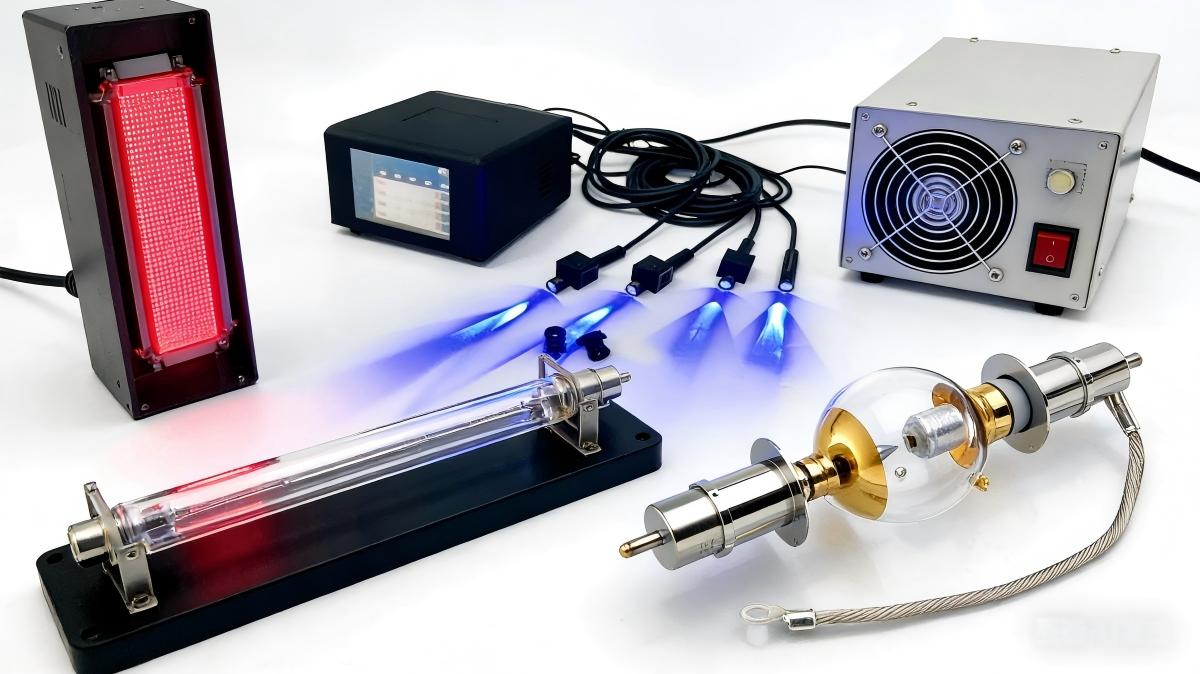
2. Light-emitting diode (UV-LED)
Ultraviolet light is generated through electron-hole recombination in semiconductor materials, representing an emerging eco-friendly light source.
lCore wavelength bands: 265 nm, 275 nm, 310 nm, 365 nm, and 395 nm (these are the mainstream bands for UVC LEDs; deep ultraviolet LED technology operating below 222 nm is still under development).
lFeatures: mercury-free, low power consumption, long lifespan, compact design, rapid startup, and modularity; however, the power density and cost of deep ultraviolet (200–250 nm) radiation still require optimization.
lApplications: portable disinfection, water disinfection, surface sterilization, curing, and biological detection.
3. Laser source (UV laser)
Ultraviolet light is generated through laser frequency doubling technology, exhibiting extremely high monochromaticity and directionality.
lCore wavelengths: 266 nm, 355 nm (third-generation frequency), and 405 nm (semiconductor laser).
lCharacteristics: Excellent monochromaticity, small light spots, extremely high energy density, precise controllability; however, high cost and complex equipment requirements.
lApplications: high-precision lithography, microfabrication, laser marking, biomedical applications, and semiconductor manufacturing.
4. Other special artificial UV light sources
(1) Black light lamp (BLB): A type of low-pressure mercury lamp that filters visible light and primarily emits UVA radiation at 365 nm.
Applications: Fluorescence detection, anti-counterfeiting, insect trapping.
(2) Metal halide lamps: Metal halides are added to mercury lamps to broaden the spectral range and enhance luminous efficacy.
Applications: Industrial curing, plant growth, stage lighting.
(3)Deuterium lamp: A UV light source generated by deuterium gas discharge, emitting a continuous spectrum ranging from 190 to 400 nm with characteristic spectral lines at 486.0 nm, 583.0 nm, and 656.1 nm, suitable for wavelength calibration.
Applications: spectrophotometer, spectral analysis, scientific research and testing.
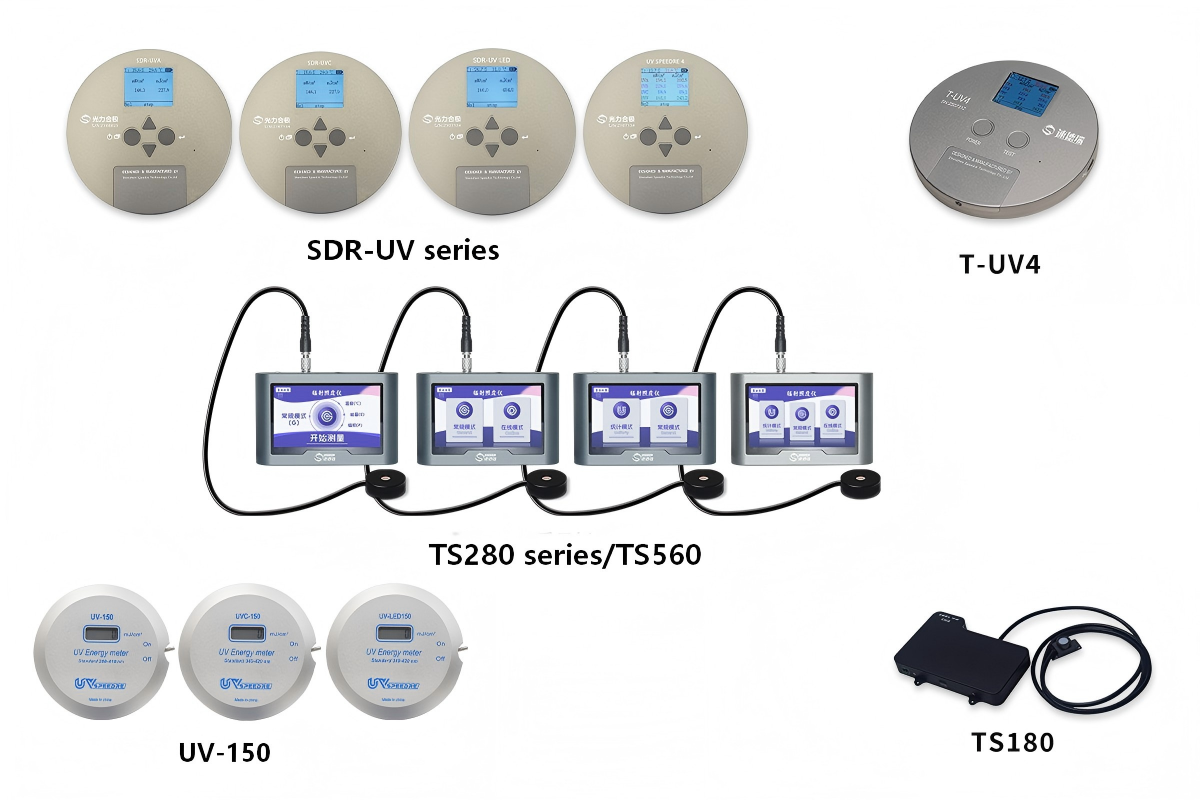
To precisely meet the detection requirements of various UV light sources, Speedre has launched a comprehensive UV detection product series that delivers high accuracy and strong adaptability, covering everything from specialized wavelength-based testing to multi-domain general measurement applications. The UVA/UVB/UVC/UVV-specific UV energy radiometers (SDR-UV series) feature simultaneous multi-parameter measurement capabilities, capturing data on UV energy, light intensity, and temperature concurrently. When paired with data analysis software, they enable curve visualization and report generation, suitable for testing scenarios involving mercury lamps, xenon lamps, UV-LEDs, and other light sources. The Xenon Irradiometer (TS560), specifically designed for xenon lamps and simulated sunlight sources, adopts a separate host-unit and probe design, supports plug-and-play functionality across multiple probes, offers wide-range automatic switching, and is ideal for xenon lamp aging tests and UV aging evaluations, providing reliable data for material weather resistance testing. Additionally, the Intelligent UV Radiometer (TS280) spans the entire spectrum of UV applications—including sterilization, curing, printing, and aging processes. Equipped with high-sensitivity sensing technology and interference-resistant design, it ensures measurement accuracy in complex environments, meeting quantitative demands across industrial production, medical disinfection, and scientific research applications.